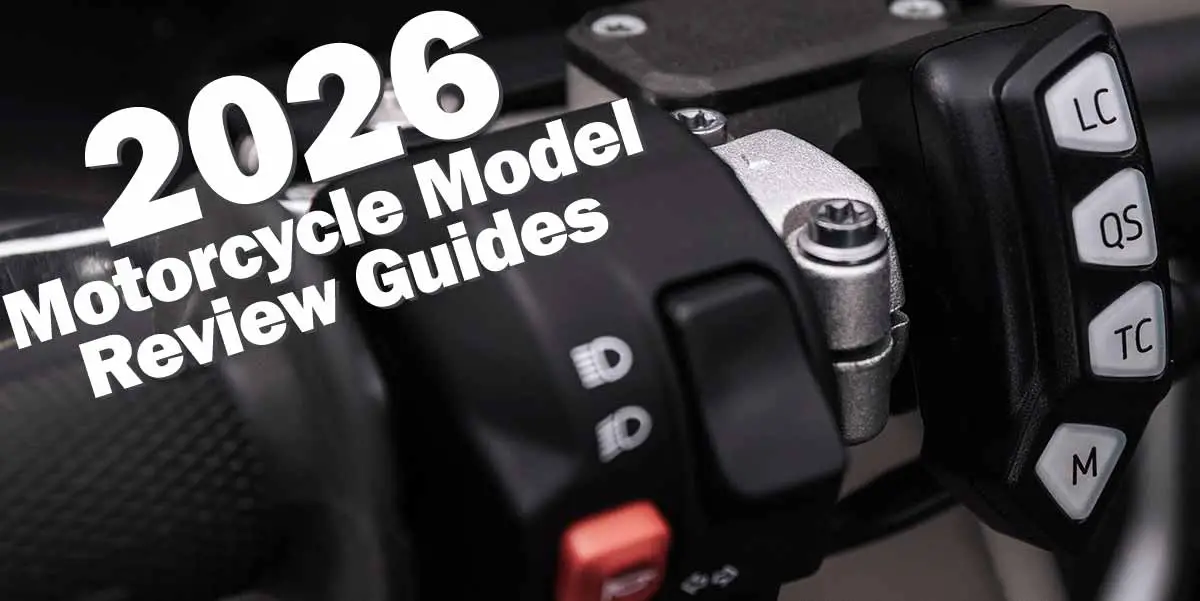

Choose manual clutch control of the six-speed gearbox, or activate E-Clutch via the TFT screen and ignore the lever. That’s it. From pulling away to shifting and stopping, just use the gear lever – E-Clutch handles the rest, smoothly and instantly, like a pro. You can’t stall. Traffic’s easier. And if you want to use the clutch? Go right ahead.
Review – Key Features – Features & Benefits – Specifications
2026 Honda CB500 Hornet E-Clutch: MANUALLY DISENGAGE.
Introducing the 2026 Honda CB500 Hornet E-Clutch…
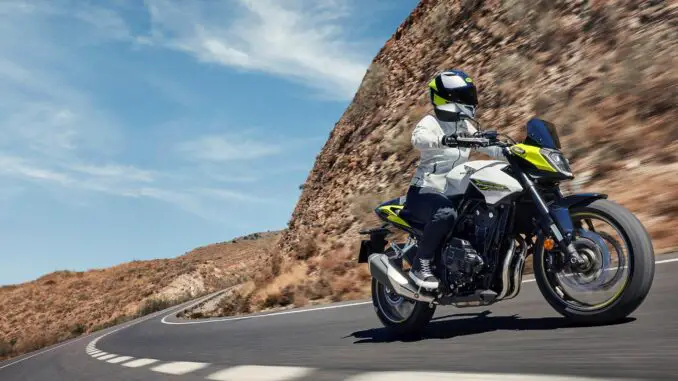
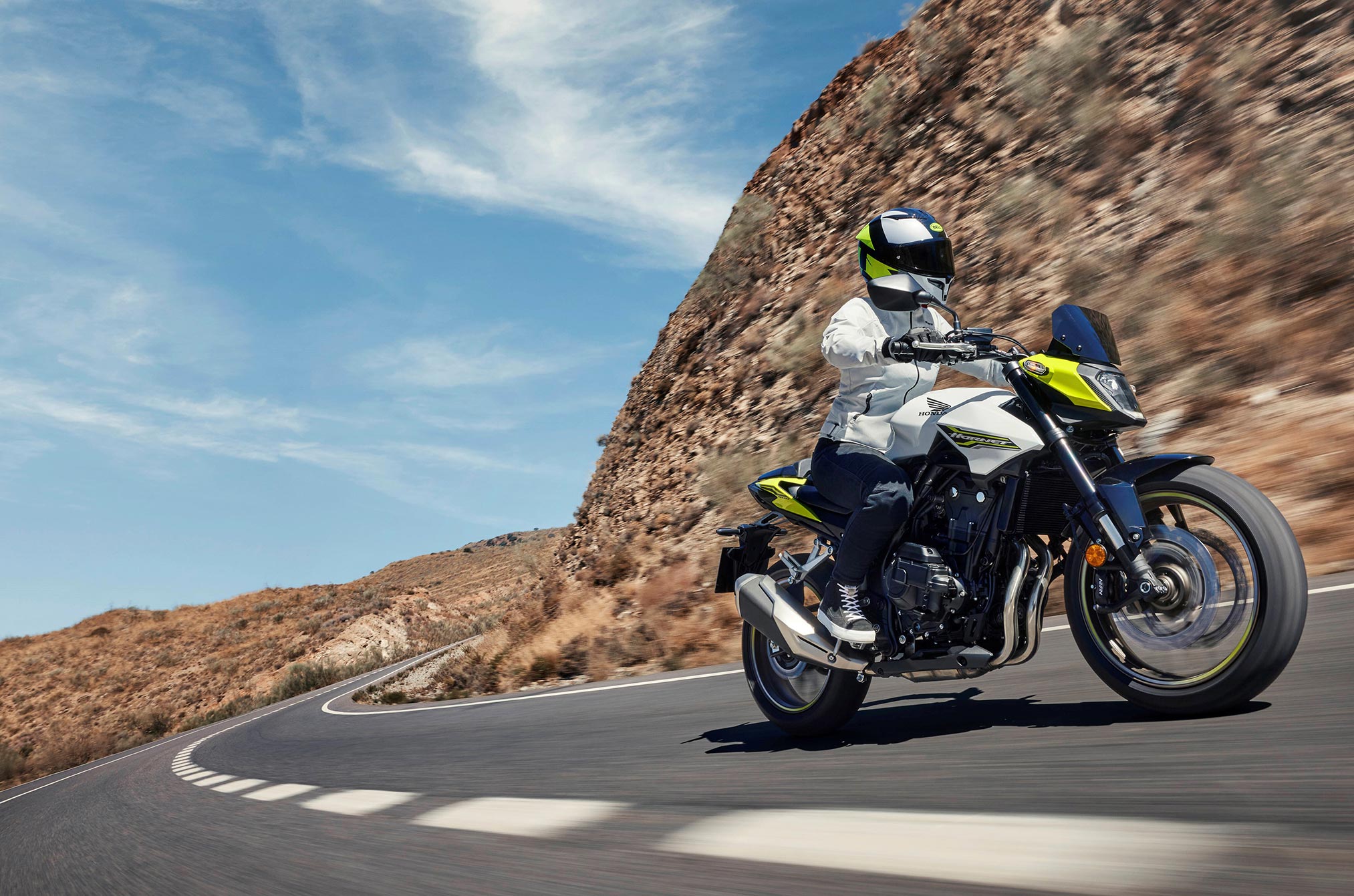
For 2026, Honda’s middleweight naked offering proudly joins the brand’s iconic Hornet family. The newly named CB500 Hornet combines the proven performance and versatility of Honda’s parallel-twin platform with a streetfighter aesthetic, resulting in a motorcycle that blends precision engineering, everyday usability and pure riding enjoyment.
Own the streets with style
Step into the streetfighter scene with ease and affordability. With a lower MSRP for 2026, the CB500 Hornet puts aggressive style and real-world performance within reach. No cutting corners here: you get the same sharp stance, quick handling, and approachable power that builds confidence fast. Lightweight, versatile, and now turning heads in Matte Black Metallic, this is next-level thrill meets next-level value.
Ready for the riding buzz? You need our new CB500 Hornet. Aggressive, streetfighter style has big Hornet DNA coursing through it. Loaded with a responsive A2-friendly twin-cylinder engine and agile, high-quality chassis it’s built to whip through the city or twisting backroads. And premium tech – including full colour 5-inch TFT display, Honda RoadSync with on-screen turn-by-turn navigation – and HSTC rear grip management keeps you entertained, connected and safe. Join the hive.
Now with E-Clutch
Unique to Honda, E-Clutch takes riding to the next level. Choose manual clutch control of the six-speed gearbox, or activate E-Clutch via the TFT screen and ignore the lever. That’s it. From pulling away to shifting and stopping, just use the gear lever – E-Clutch handles the rest, smoothly and instantly, like a pro. You can’t stall. Traffic’s easier. And if you want to use the clutch? Go right ahead.
Command the ride
Handle the city. With a naturally upright riding position that puts you in charge. Lightweight 5-spoke wheels, sporty aluminum swingarm and footpegs shave mass for super-fast, effortless steering. Dual 296mm discs and Nissin two-piston radial-mount calipers offer strong, progressive braking. Dialled-in Showa 41mm Separate Function Fork-Big Piston (SFF-BP) USD forks mean you can push hard into corners with all the feedback for grip you need. And then some.
Get noticed
A cut, low-set stance locks in the imposing street-fighting attitude of a bike built to rip it up. Wide handlebars give you the leverage and control to slip through gaps, scorch corners, and keep full awareness of what’s around you. And you’ll be seen too: the piercing headlight ensures presence by day, while its broad beam cuts through the dark for confident cornering at night.
Honda E-Clutch technology comes to the CB500 Hornet for 2026 – expanding the possibilities of manual motorcycles, offering increased performance, and smoother operation for the A2 compliant naked
Model updates: Honda’s A2 naked twin-cylinder streetfighter CB500 Hornet joins the Honda E-clutch family for 2026, with the pioneering technology opening up street style, increased dynamism and the iconic Hornet name to a range of new riders. Honda E-Clutch, available as an option on the CB500 Hornet for the first time, allows the rider to start, stop and change gear without using the clutch lever – just the shift pedal, making the most of the A2 compliant power and torque of the 471cc engine – at 35kW and 43Nm. The high-quality chassis specification includes 41mm Showa SFF-BP USD forks, Showa rear shock, dual discs up front with four-piston calipers and Honda Selectable Torque Control. The aggressive styling packs a LED headlight, while a 5-inch TFT screen offers Honda RoadSync smartphone connectivity, operated by a simple to use backlit 4-way toggle switch.
The naked CB500F – originally launched in 2013 alongside the adventure-styled CB500X (now NX500) and fully-faired CBR500R – quietly proved that one of Honda’s tried-and-trusted formulas for building popular motorcycles had an enduring relevance.
That formula? An entertaining twin-cylinder engine wrapped in a simple, lightweight, sporty chassis. And, while a 35kW peak power output made it suitable for A2 licence holders, the CB500F always offered so much more than ‘entry level’ performance. Sure, it was an easy machine to manage, ride and learn on, but those same attributes also made it a genuine pleasure for those stepping up from a 125 or coming down from a bigger machine. Sensible running costs, whatever the situation, added strongly to the appeal.
In 2019, the CB500F was redrawn with uncompromising lines that elevated its technical and mechanical aspects and 22YM saw it receive high-quality suspension in the form of Showa 41mm SFF-BP USD forks and dual front discs, plus new lightweight wheels and swingarm.
For 2024 Honda’s formula for the 500 streetfighter continued to evolve. Joining an iconic Honda family, the CB500F became the new CB500 Hornet and followed in the wheel tracks of the impressive CB750 Hornet with aggressive new styling, high-end technology and a variety of detail upgrades that made it a popular addition to the Hornet family.
For 2026, the CB500 Hornet, alongside its NX500 and CBR500R stablemates, join the list of Hondas available with Honda E-Clutch technology, which is designed to make motorcycling, from beginner right through to expert, even more enjoyable – and even more exciting.
The CB500 Hornet gets a fresh edge as it rides into 2026 with the addition of the option of Honda E-Clutch technology. The new transmission brings increased performance, and dynamism to the popular naked.
The system takes elements of the technology and performance of quickshifters, manually-operated clutches and Honda’s Dual Clutch Transmission technology to create a unique blend of these well-proven approaches, in an ultra-compact system.
It bolsters the already impressive spec list that is packed with premium tech such as a five-inch TFT screen with Honda RoadSync connectivity, Honda Selectable Torque Control, Showa 41mm SFF-BP USD forks and dual radial-mount four-piston brake calipers.
All of this is wrapped up in an aggressively styled naked streetfighter package to bring street style and an iconic nameplate to a wide range of riders.
2026 Honda CB500 Hornet E-Clutch Totalmotorcycle.com Key Features
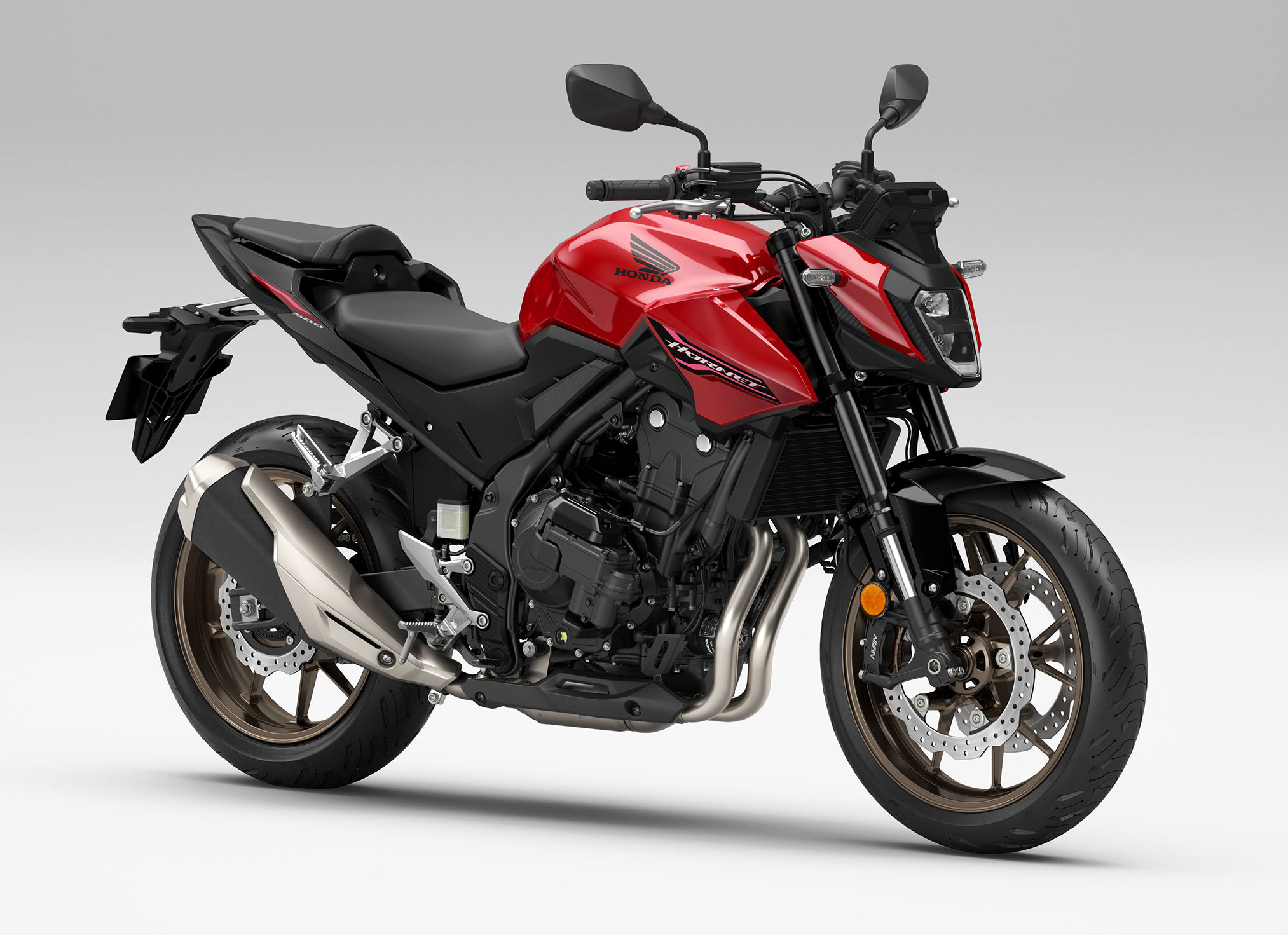
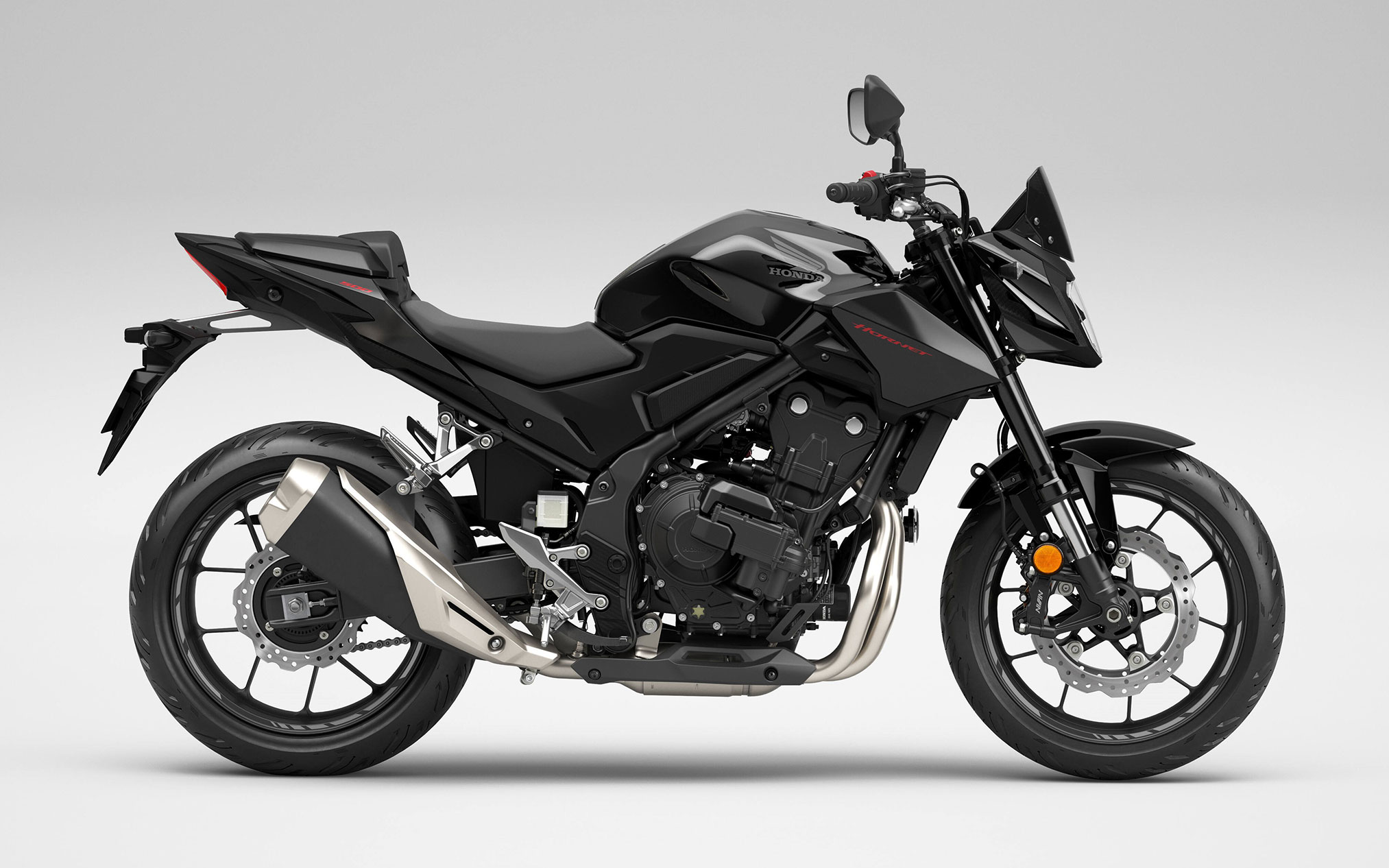
The 2026 CB500 Hornet will be available in the following new colour options:
- *NEW*Graphite Black with Mat Gunpowder Black Metallic
- *NEW*Grand Prix Red with Graphite Black Metallic
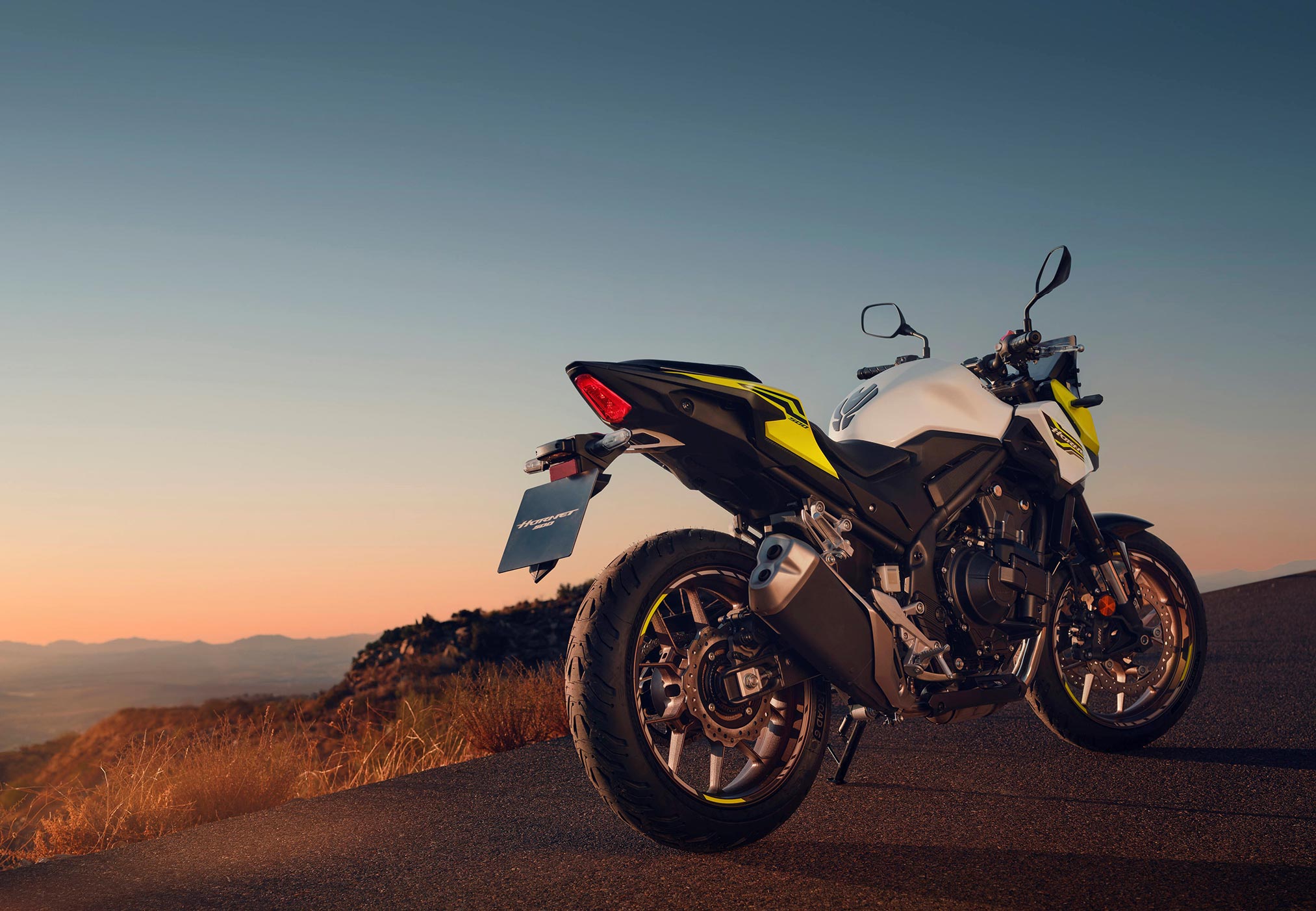
- *NEW*Pearl Horizon White with Lemon Ice Yellow
HISTORY
Since it was originally launched in 2013, the naked CB500F has quietly proven that one of Honda’s tried-and-true formulas for producing popular motorcycles has lost none of its relevance. That formula? An entertaining twin-cylinder engine wrapped in a simple, lightweight, sporty chassis that’s as much fun for a veteran rider as it is for those still building their riding experience.
While its compact dimensions and welcoming manners made the CB500F an easy machine to manage, ride and learn on, those same attributes also made it a genuine pleasure for experienced riders who wanted to explore just what it could do on the weekend. Sensible running costs added to the appeal.
In 2019, the CB500F was redrawn with aggressive new lines that elevated its appeal. Having proved its continued popularity, the twin-cylinder naked bike received engine- and chassis-related improvements for the 2022 model year. Continuing its evolution, the 2024 CB500F benefited from an even more aggressive look, Honda Selectable Torque Control (HSTC) and a variety of detail upgrades.
For 2026, the model gets a new name—the CB500 Hornet.
2026 Honda CB500 Hornet E-Clutch Totalmotorcycle.com Features and Benefits
DESIGN / STYLING
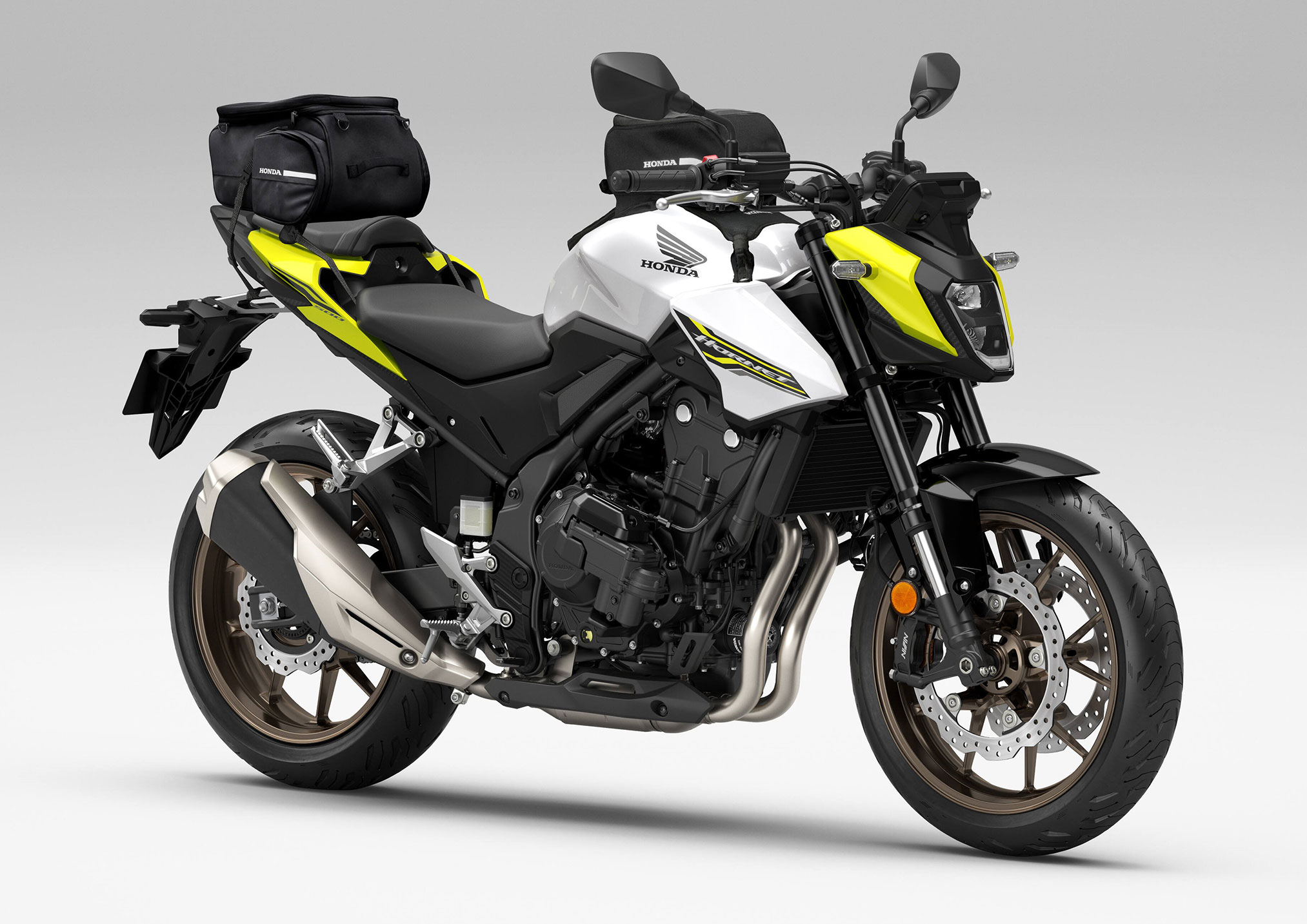
The CB500 Hornet has a streetfighter-inspired design with a low, forward-biased stance that gives the bike a poised, ready-to-ride look. Sharp, geometric bodywork defines the front end, which sports side air ducts that guide airflow cleanly around the upper tank area. The side shrouds interlock with the fuel tank and fully emphasize the engine, while the side covers and seat unit continue the theme of muscular angularity. The compact front fender is drawn directly from the CB650R.
Aerodynamic shaping around the front of the bike helps deliver a natural, linear steering feel. The LED headlight design has good beam penetration but also emits wide light distribution, for exceptional visibility when riding at night, particularly when cornering. It’s matched to a sleek taillight; all lighting is LED.
A tapered handlebar provides feel and leverage, while the sporty aluminum footpegs complement the aggressive character. The neutral riding position is comfortable and accommodates a wide range of riders.
Meter / Controls
The five-inch full-color TFT screen uses optical bonding to maximize visibility in bright sunlight. The gap between the cover glass and TFT screen is sealed with resin to minimize glare and optimize backlight transmittance. Owners can customize the display patterns (Bar, Circle and Simple), and navigating through the display settings is simple and intuitive thanks to the backlit four-way toggle switch located on the left side of the handlebar.
ENGINE / DRIVETRAIN
The CB500 Hornet’s 471cc, eight-valve, liquid-cooled, parallel twin-cylinder engine layout offers a well-proportioned balance of physical size and enjoyable power output, with an energetic, high-revving character and zippy top end. The engine’s overall performance and character belie its relatively small capacity. Acceleration is impressive, due to good low-to-midrange power and torque in the 3,000 to 7,000 rpm range.
The CB500 Hornet features Honda Selectable Torque Control (HSTC), which compares front and rear wheel speeds to monitor rear slip; when it’s detected, the fuel injection is controlled to smoothly reduce torque, offering enhanced control, especially in slippery conditions. HSTC can be turned off completely with the four-way toggle switch on the left side of the handlebar.
Feeding the programmed electronic fuel injection (PGM-FI) is a relatively straight shot of air through the airbox and throttle bodies. The ignition timing and air/fuel ratio are optimized to create strong, low-rpm acceleration and smooth, linear throttle response. The exhaust muffler features dual exit pipes, giving a sporting edge to each pulse, as well as a rasping high-rpm howl.
Bore and stroke are 67.0mm x 66.8mm, with a compression ratio of 10.7:1. The crankshaft pins are phased at 180°, and a primary couple-balancer sits behind the cylinders, close to the bike’s center of gravity. The primary and balancer gears use scissor gears, minimizing noise. The crank counterweight is specifically shaped for couple-balance, and its light weight allows the engine to spin freely, with reduced inertia.
Acting as a stressed member, the engine complements the frame’s rigidity, with four hangers on the cylinder head. Internally, the head uses roller rocker arms. Shim-type valve adjustment allows them to be light, for low valve-spring load and minimal friction.
The pin surfaces of the silent (SV Chain) cam chain are treated with Vanadium, minimizing friction, with good protection against wear. Inlet-valve diameter is 26.0mm, while exhaust-valve diameter is 21.5mm.
The piston shape is carefully designed to minimize noise at high rpm. Friction is minimized by striations on the piston skirt (a finish that increases surface area and introduces gaps in which oil can flow for better lubrication). The “triangle” proportion of crankshaft, main shaft and countershaft is efficiently compact. The crankcases use centrifugally cast thin-walled sleeves; their internal design reduces the pumping losses that can occur with a 180° phased firing order. A deep sump reduces oil movement under hard cornering and braking; oil capacity is 3.2 liters. The smooth-shifting, six-speed transmission is managed by an assist/slipper clutch.
CHASSIS / SUSPENSION
The CB500 Hornet’s light, strong 35mm diameter steel diamond-tube mainframe has a tuned degree of yield that gives plenty of feedback to the rider as road surfaces change. The shape and position of the engine mounts, plus the frame’s rigidity balance, keep vibration to a minimum.
Geometry
The CB500 Hornet’s curb weight is 414 pounds (with all fluids and a full tank of fuel), and its 49.7/50.3 front/rear bias supports light yet predictable steering and great overall handling. Wheelbase is 55.5 inches, with rake and trail at 25.5°/4.0 inches (101mm), respectively.
The tapered handlebar offers intuitive feel and leverage. Seat height is low at 31.1 inches, making the CB500 Hornet very easy to manage, and its neutral riding position comfortably accommodates riders of varying heights. Overall dimensions are 81.9 inches long, 31.4 inches wide and 41.7 inches high, with ground clearance of 5.7 inches. The fuel tank holds 4.5 gallons.
Suspension
With the aim to heighten all-around handling performance, this model has a Showa 41mm inverted Separate Function Fork Big Piston fork (SFF-BP) with 4.7 inches of wheel travel. By dividing the functions—Big Piston pressure-separation damper in one leg, spring mechanism in the other—reaction and ride quality are maximized (the CB650R uses the same setup).
The single-tube shock absorber (as found on larger-capacity sport bikes) has a large-diameter piston that ensures excellent response and temperature management; it features five-stage preload adjustment with an optimized spring rate and damping settings to match the fork. Rear-wheel travel is 4.7 inches.
Wheels
The front-wheel width is 3.5 inches with a 120/70-ZR17 tire, and the rear is 4.5 inches with a 160/60-ZR17 tire.
Brakes
Dual two-piston hydraulic calipers work the front wheel’s 296mm petal-style discs. A single one-piston hydraulic rear caliper works a 240mm petal-style rotor.
Additional Styling & Equipment
- Streetfighter style subtly incorporates aerodynamic aids
- LED lighting front and rear
- Five-inch full colour TFT screen includes Honda RoadSync connectivity for on-screen turn-by-turn navigation and access to other smartphone functions
- Simple left-hand switchgear is easy to use and backlit for night-time operation
The CB500 Hornet’s aggressive looks are inspired by the streetfighter DNA of its big sibling and was led by the design banner ‘Digital Dynamism’. A sensual form front to rear, it also offers mass contrast, with a ‘wedge’ silhouette weighted forward with very slim rear section, muscular fuel tank and sharp new nose cone fairing.
And there’s function to the form; the geometric angles of the fairing also incorporate headlight side ducts that channel airflow smoothly around to the upper fuel tank area. This aerodynamic package contributes to a linear steering feel with increased handling agility. An LED headlight design maintains beam penetration and throws out a wide light distribution for increased visibility when riding – and cornering – at night. It’s matched to a new sleek taillight, and all lighting is LED.
Premium technology, in the form of a five-inch full colour TFT screen inherited from the CB1000R, uses optical bonding to improve visibility in bright sunlight. By sealing the gap between the cover glass and TFT screen with resin, glare is reduced and backlight transmittance improved. It’s customisable between Bar, Circle and Simple display patterns and also offers the IOS/Android smartphone connectivity of Honda RoadSync.
This feature – alongside a simple, easy-to-use, backlit four-way toggle-switch on the left handlebar – allows straightforward, on-screen turn-by-turn navigation as well as the option (via a Bluetooth helmet headset) for the rider to make calls or listen to music. All an owner has to do is download the Honda RoadSync app from either the Play Store or the App Store, connect to the CB500 Hornet, and go.
Tapered handlebars offer intuitive feel and leverage. Seat height is low at 785mm, making the CB500 Hornet very easy to manage, and its neutral riding position comfortably accommodates riders of any height.
Purposeful-looking aluminium footpegs are lightweight and add a sporting feel. Overall dimensions are 2080mm x 800mm x 1060mm, with 145mm ground clearance. The fuel tank holds 17.1L including reserve and combined with the engine’s excellent 3.5L/100km (28.6km/litre) fuel economy, gives a range of over 485km.
Heightening safety, Emergency Stop Signal (ESS) system operates (and self-cancels) the rear indicators during a hard-stop situation, alerting road users behind. The indicators also auto-cancel in normal use for heightened convenience in urban environments.
Chassis
- 41mm Showa Separate Function Fork Big Piston (SFF-BP) USD forks
- Dual 296mm discs, Nissin radial mount four-piston calipers
- Lightweight wheels and swingarm
Light and strong, the 35mm diameter steel diamond-tube mainframe has a tuned degree of yield that gives plenty of feedback to the rider as road surfaces change. The shape and position of the engine mounts, plus the frame’s rigidity balance, keep vibration to a minimum.
Wheelbase is 1410mm with rake and trail of 25.5°/102mm, and front/rear bias percentage is a perfect 50/50. Kerb weight is 188kg.
Like its sibling the CB750 Hornet, the CB500 Hornet features Showa 41mm Separate Function Fork Big Piston (SFF-BP) USD forks which divide the functions – Big Piston pressure separation damper in one leg, spring mechanism in the other – and reaction and ride quality are top draw.
The swingarm is constructed from 2mm steel and employs a hollow cross member; it is stiff rotationally, and flexible laterally to improve handling. The single-tube Showa rear shock absorber, with its large-diameter piston, ensures excellent response and temperature management and features 5-stage preload adjustment.
Dual 296mm front discs are worked by Nissin radial-mount, four-piston calipers; the rear 240mm disc by a single-piston caliper. Lightweight rims use 5 Y-shaped spokes; the 3.5-inch front wears a 120/70-ZR17 tyre, and the 4.5-inch rear a 160/60-ZR17 tyre.
Engine
- Lively twin-cylinder powerplant equipped with Honda Selectable Torque Control (HSTC)
- New PGM-FI settings improve low-rpm acceleration and power delivery across the rev-range
- Assist/slipper clutch eases upshifts and manages rear wheel through downshifts
Delivering maximum A2-licence performance, the friendly 471cc, 8-valve liquid-cooled parallel twin-cylinder layout offers a well-proportioned balance of physical size and willing, enjoyable power output, with an energetic, high-revving character and zappy top end. And it’s very much an engine whose overall performance and character belie its relatively small capacity; peak power of 35kW arrives at 8,500rpm, with 43Nm torque delivered at 6,500rpm.
A 2024 addition was Honda Selectable Torque Control to manage rear wheel traction for increased peace of mind and a real boost for rider confidence. The system compares front and rear wheel speeds to detect rear slip and controls the fuel injection to smoothly reduce torque. HSTC can also be turned off completely if the rider wishes.
Feeding the PGM-FI fuel injection is a more-or-less straight shot of airflow through the airbox and throttle bodies. Optimisation of ignition timing and air/fuel ratio equals more powerful acceleration feel from low rpm, with linear power delivery and throttle feel. The exhaust muffler features dual exit pipes, giving a sporting edge to each pulse, and a rasping high-rpm howl.
Bore and stroke are set at 67mm x 66.8mm and compression ratio is 10.7:1; the crankshaft pins are phased at 180° and a primary couple-balancer sits behind the cylinders, close to the bike’s centre of gravity. The balancer gears are scissor gears, reducing noise. The crank counterweight is specifically shaped for couple-balance and its light weight allows the engine to spin freely, with reduced inertia.
Acting as a stressed member, the engine complements the frame’s rigidity with four frame hangers. Internally the cylinder head uses roller rocker arms; shim-type valve adjustment allows them to be light, for lower valve-spring load and reduced friction.
A silent (SV Chain) cam chain has the surface of its pins treated with Vanadium, reducing friction with increased protection against wear. Inlet valve diameter is 26.0mm with exhaust valve diameter of 21.5mm. Piston shape is carefully designed to reduce piston ‘noise’ at high rpm. Friction is reduced by striations on the piston skirt (a finish that increases surface area, introducing gaps in which oil can flow for better lubrication).
The ‘triangle’ proportion of crankshaft, main shaft and countershaft is efficiently compact and the crankcases employ centrifugally cast thin-walled sleeves; their internal design reduces the ‘pumping’ losses that can occur with a 180° phased firing order. A deep sump reduces oil movement under hard cornering and braking; oil capacity is 3.2L.
A slick-changing six-speed gearbox is managed by an assist/slipper clutch, eliminating rear wheel ‘hop’ under hard braking and downshifting.
Honda E-Clutch
- Advanced Honda technology that brings ‘next level’ sporty riding performance
- Also allows the rider to start, stop and change gear without using the clutch lever – just the gear shift pedal
- Honda E-Clutch also allows normal operation of the clutch lever
- Brings more enjoyment and flexibility across a wide range of scenarios, for a ‘next level’ riding experience
- Available as an option from new
- Available for first time on A2 licence motorcycles on CBR500R, NX500 and CB500 Hornet
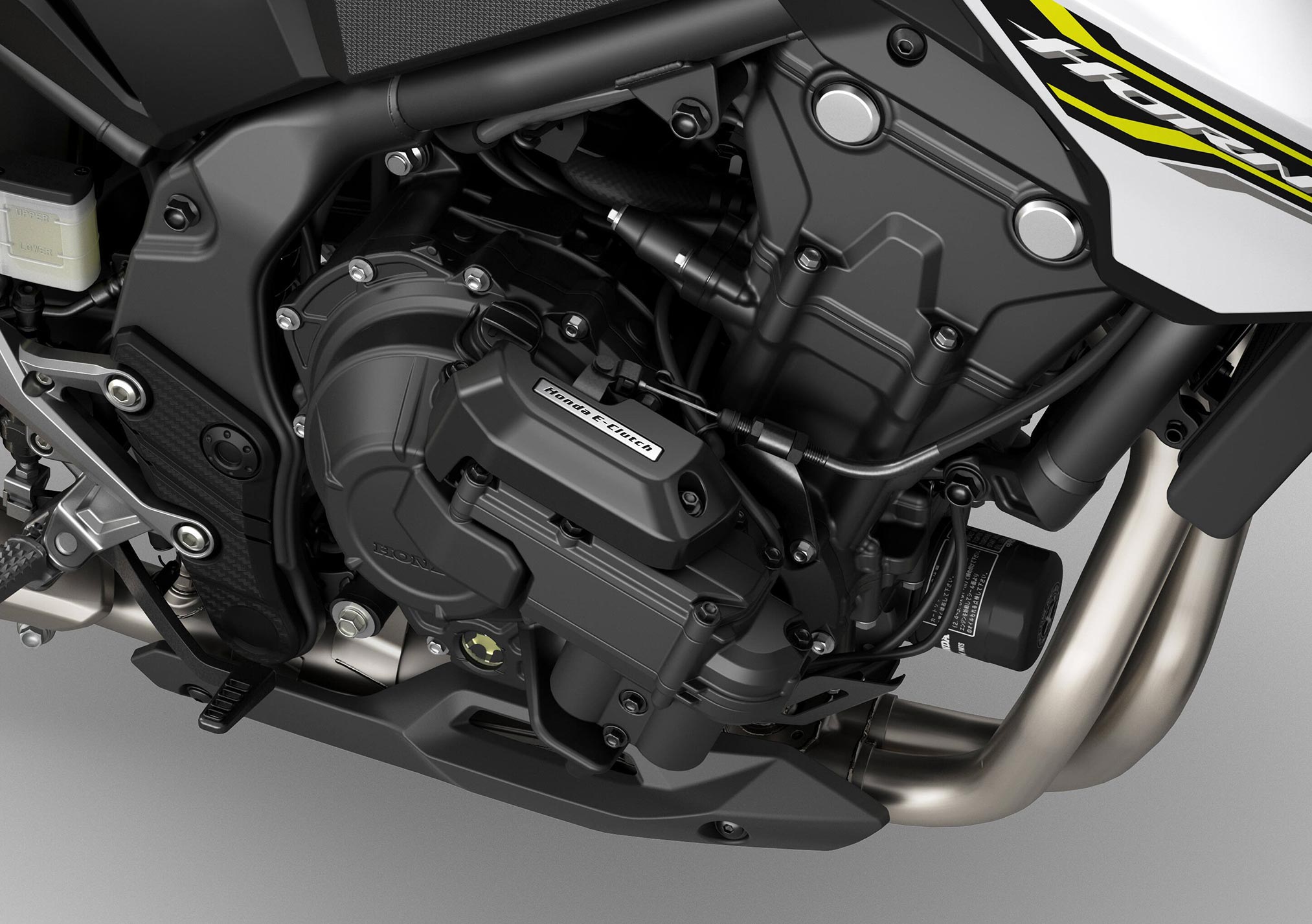
The Honda E-Clutch system – which debuted on the 2024 CB650R and CBR650R – brings ‘next level’ riding enjoyment and performance, allowing consistent gear changes that are faster and smoother than a quickshifter. For the first time, it will now be available for A2 licence motorcycles for 26 year model – namely the CBR500R, NX500 and CB500 Hornet – giving more young riders the opportunity to sample class-leading technology and sporty riding.
As well as performance, it offers simplicity of operation. The clutch lever is not needed when pulling away or coming to a stop and there’s no need to use the lever to make a shift either up or down the gearbox. The rider simply operates the shift pedal to change gear.
A half clutch position smooths the up/down shift, and the engine’s ignition timing and fuel injection are also controlled, based on parameters such as vehicle speed, throttle opening angle, engine rpm, pressure on the shift pedal, clutch motor reduction gear angle, engine countershaft speed and gear position. The clutch operation itself is performed through an actuator unit with two motors situated inside the right-hand engine cover.
The Honda E-Clutch also allows the rider to select an ‘operation feel’ to set the strength of the force required on the shift pedal to make a gear change. Three settings are available: HARD, MEDIUM, and SOFT, each of which can be chosen independently for upshifting and downshifting. The technology will also advise the rider to shift down – via a symbol on the instrument panel – if it detects the motorcycle is in a high gear at a certain speed.
And the system is the ultimate in versatility, as the clutch lever can be used as normal at any time. After use, the Honda E-Clutch system will re-activate after less than a second above a certain engine rpm, and after 5 seconds at lower engine speeds. Should the rider wish to turn off the system for a particular ride, this is also possible via the switchgear on the left handlebar, once the vehicle is stationary and in neutral. The change to manual operation is indicated by a letter ‘M’ on the instrument panel.
Junya Ono, Large Project Leader, Honda E-Clutch: “Our Honda E-Clutch is designed to offer motorcyclists a new kind of experience that can make their riding even more fun and exciting. It also adds peace of mind and comfort to town riding or the daily commute. We hope that many riders will try this system to enjoy the unique mix of sportiness and flexibility it offers.”
Accessories
A range of Genuine Honda Accessories are available for the CB500 Hornet, as individual items or grouped in packs, and ready to bolt straight on:
Style Pack
For enhanced sporty looks, the Style Pack includes a Meter Visor for the instrument display and added wind deflection, a protective Tank Pad prevents paint damage to the tank, a Seat Cowl for the passenger seat that matches the colour of the rear panels of the bike, and a Wheel Stripe kit for a flash of extra colour.
Comfort Pack
Commuting made easier with the Heated Grips for colder days, an ACC socket to conveniently charge electronic devices while stored under the seat and a Main Stand that makes for easy chain maintenance and safer parking on uneven surfaces.
Travel Pack
Includes the 3L Tank Bag with see-through pocket for smartphones and a rain cover and the 15L Rear Seat Bag, expandable to 22L, which provide flexible and convenient carrying capacity for the weekend trips.
Outside of the main packs, a 35L Top Box and the Rear Carrier required for its installation are also available. All the accessories featured in packs can also be purchased individually.
2026 Honda CB500 Hornet E-Clutch – Totalmotorcycle.com USA Specifications/Technical Details
US MSRP Price: $5899 USD
Canada MSRP Price: $ TBA CDN (includes Freight, PDI and Fees)
Europe/UK MSRP Price: £ See Dealer for Pricing in GBP (On The Road inc 20% Vat)
| ENGINE | |
| Type | 471cc liquid-cooled four-stroke, parallel twin |
| Valvetrain | DOHC; four valves per cylinder |
| Bore x Stroke | 67.0mm x 66.8mm |
| Compression Ratio | 10.7:1 |
| Induction | Programmed electronic fuel injection (PGM-FI) w/ 34mm throttle bodies |
| Ignition | Full transistorized ignition |
| Starter | Push-button electric start |
| Transmission | Six-speed manual |
| Clutch | Multiplate wet |
| Final Drive | O-ring-sealed chain; 15T / 41T |
| SUSPENSION | |
| Front | 41mm Showa Separate Function Fork Big Piston (SFF-BP) inverted telescopic fork; 4.7-inch travel |
| Rear | Pro-Link® single shock absorber w/ nine-position spring preload adjustability; 4.7-inch travel |
| BRAKES | |
| Front | Dual two-piston hydraulic calipers w/ 296mm petal-style discs; ABS |
| Rear | Single one-piston hydraulic caliper w/ 240mm petal-style disc; ABS |
| TIRES | |
| Front | 120/70R-17 |
| Rear | 160/60-17 |
| MEASUREMENTS | |
| Rake | 25.5º |
| Trail | 4.0 inches (101mm) |
| Length | 81.9 inches |
| Width | 31.4 inches |
| Height | 41.7 inches |
| Ground Clearance | 5.7 inches |
| Seat Height | 31.1 inches |
| Wheelbase | 55.5 inches |
| Fuel Capacity | 4.5 gallons |
| Curb Weight* | 414 pounds |
| OTHER | |
| Color | Matte Black Metallic |
| Warranty | 1 year |
*Includes all standard equipment, required fluids and full tank of fuel—ready to ride Meets current EPA standards
Models sold in California meet current CARB standards and may differ slightly due to emissions equipment Specifications subject to change
2026 Honda CB500 Hornet E-Clutch – Totalmotorcycle.com Canada Specifications/Technical Details
TBA
2026 Honda CB500 Hornet E-Clutch – Totalmotorcycle.com Europe Specifications/Technical Details
| 2026 CB500 Hornet | 2026 CB500 Hornet E-Clutch | |
| ENGINE | ||
| Engine Type | Liquid-cooled 4-stroke DOHC parallel twin | |
| Engine Displacement | 471 cc | |
| Bore x Stroke (mm) | 67 mm x 66.8 mm | |
| Compression Ratio | 10.7:1 | |
| Max. Power Output | 35 kw (47hp) at 8,500 rpm | |
| Max. Torque | 43 Nm at 6,500 rpm | |
| Stationary Noise Level (dB) | 89 dB (A) | |
| Max Speed | 176 km/h | |
| Oil Capacity | 3.2 L | |
| Starter | Electric | |
| FUEL SYSTEM | ||
| Carburation | PGM FI electronic fuel injection | |
| Fuel Tank Capacity | 17.1 L | |
| CO2 Emissions WMTC | 80 g/km | |
| Fuel Consumption | 3.5L/100km | |
| ELECTRICAL SYSTEM | ||
| Battery Type | AGM | |
| Battery Capacity | 12 V 7.4 Ah | |
| DRIVETRAIN | ||
| Clutch Type | Wet multiplate, Assisted slipper clutch | Wet multiplate, Assisted slipper clutch, Honda E-Clutch |
| Transmission Type | 6-speed | |
| Final Drive | Chain | |
| FRAME | ||
| Frame Type | Steel diamond | |
| CHASSIS | ||
| Dimensions (L´W´H) | 2,080 mm x 800 mm x 1,060 mm | |
| Wheelbase | 1,410 mm | |
| Caster Angle | 25.5° | |
| Trail | 102 mm | |
| Seat Height | 785 mm | |
| Ground Clearance | 145 mm | |
| Kerb Weight | 188 kg | 191 kg |
| Turning radius | 2.7 m | |
| SUSPENSION | ||
| Suspension Front | Showa 41 mm SFF-BP USD forks, | |
| Suspension Rear | Prolink mono with 5 stage preload adjuster, steel hollow cross swingarm | |
| WHEELS | ||
| Wheels Front | 17M/C X MT3.5 5Y-Spoke Cast Aluminium | |
| Wheels Rear | 17M/C X MT4.5 5Y-Spoke Cast Aluminium | |
| Tyres Front | 120/70ZR17M/C (58W) | |
| Tyres Rear | 160/60ZR17M/C (69W) | |
| BRAKES | ||
| ABS Type | 2-channel | |
| Brakes Front | Dual 296 mm x 4 mm disc with Nissin radial-mount four piston calipers | |
| Brakes Rear | Single 240mm x 5 mm disc with single piston caliper | |
| INSTRUMENTS & ELECTRICS | ||
| Instruments | 5 inch TFT Meter with customisable layout | |
| Headlight | LED | |
| Taillight | LED | |
| Connectivity | Roadsync | |
| Security System | HISS | |
| HSTC | Yes | |
| Additional Features | ESS | |
All specifications are provisional and subject to change without notice.
# Please note that the figures provided are results obtained by Honda under standardised testing conditions prescribed by WMTC. Tests are conducted on a rolling road using a standard version of the vehicle with only one rider and no additional optional equipment. Actual fuel consumption may vary depending on how you ride, how you maintain your vehicle, weather, road conditions, tire pressure, installation of accessories, cargo, rider and passenger weight, and other factors.
Manufacturer Specifications and appearance are subject to change without prior notice on Total Motorcycle (TMW).